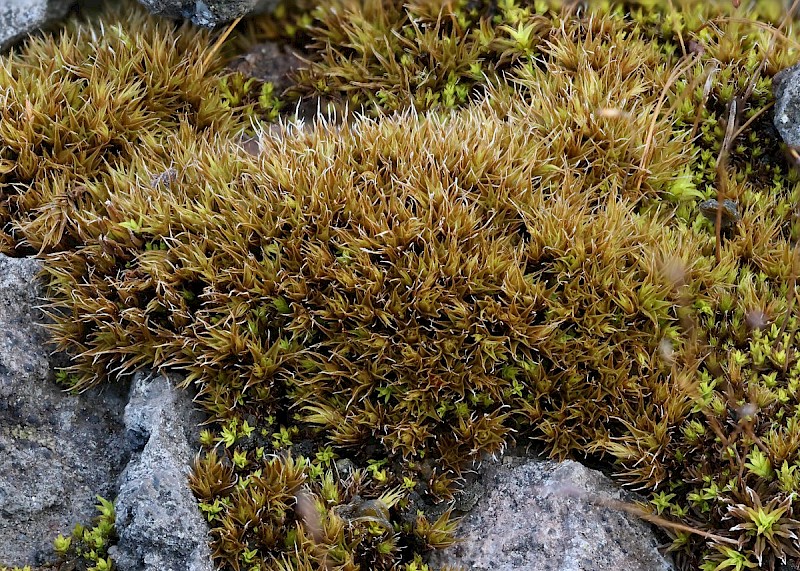
Ceratodon conicus - © Barry Stewart
(Hampe ex Muell.Hal.) Lindb.
A dioicous, acrocarpous moss which rarely produces capsules (unlike Ceratodon purpureus). It grows in skeletal habitats on thin, usually base-rich soils such as on limestone, on concrete, on walls, in quarries and in open mosaic habitats previously used as industrial land. Until recently it was regarded as a rare species almost on the brink of extinction in Britain, with scattered populations in southern England and particularly in Oxfordshire. Since 2010, after Peter Martin discovered a population in Bristol and alerted bryologists to the possibility that they may be overlooking it, a number of new populations have been found in England, Scotland and Wales. It is similar to some forms of the rather variable Ceratodon purpureus and sterile material is usually difficult to separate from it. Its leaves usually have a conspicuous hair point which give it an almost Bryum-like `ppearance and its capsules are erect rather than inclined like those of Ceratodon purpureus. Safe identication of material without capsules requires DNA analysis. It was found in West Glamorgan in Port Talbot Docks by Des Callaghan in 2024.
See Pater Martins article in Field Bryology, vol. 111, pp 26-30 (2014)

