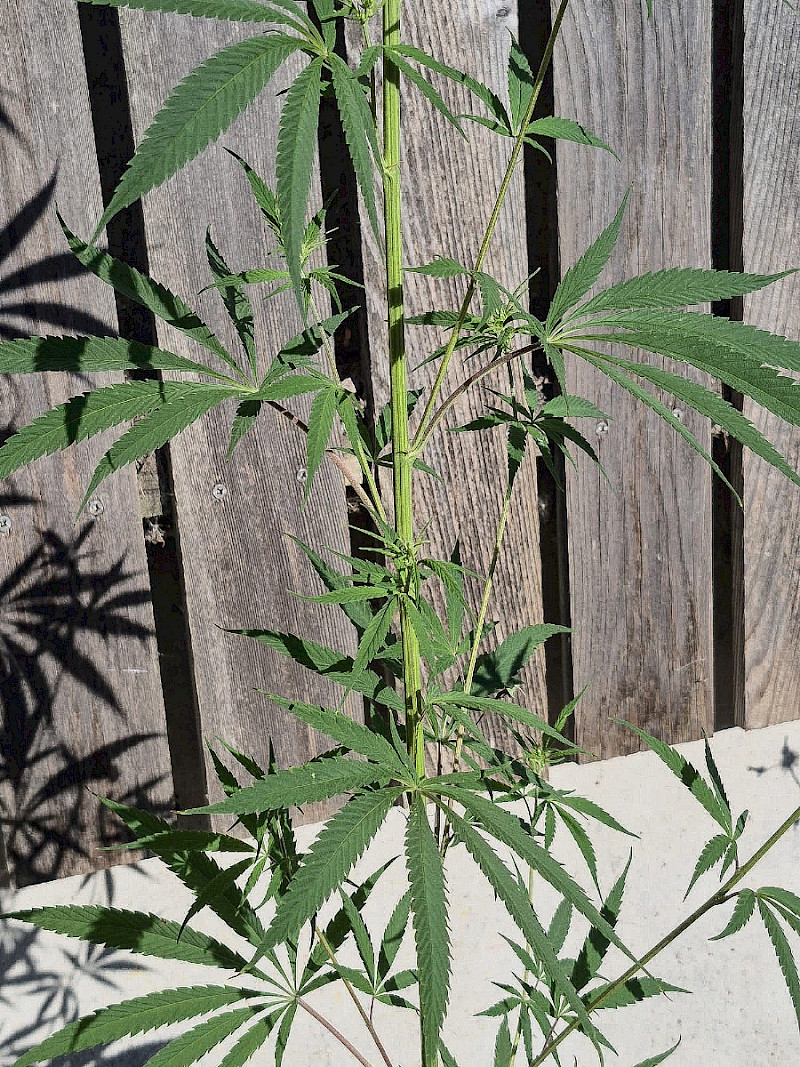
Cannabis sativa - © Gareth Stamp
Linnaeus
A tall, dioecious annual with narrow, coarsely-toothed, palm-like leaves, which is native to south and central Asia but also widespread as a neophyte or archaeophyte in most temperate regions of the world. It is sometimes found on rubbish tips, urban waste ground, places where soil has been dumped, pavements, gardens and raiways where most plants are derived from bird seed (hemp seed). These plants rarely, if ever, survive more than one growing season. It is grown commercially on a significant scale for hemp fibre in many temperate and tropical parts of the world, particularly in China and was cultivated in Britain from the 14th to the 18th Century. It is also grown on a smaller scale, illegally or otherwise, for the narcotics that it contains. It has a scattered distribution as a casual in Britain and plants occasionally occur in West Glamorgan, invariable in or near urbam centres.
Neophyte (sometimes considered as an archaeophyte)
Hemp has been the subject of a large amount of biovhemical, medical and pharmacological research and is known to contain hundreds of interesting phytochemicals. The most well known are the cannabinoid substances such as tetrahydrocannabinol (THC) whuch is well known for its psychotropic (mind altering) effects. THC is produced in the leaves and the flowers of Hemp. The greatest amounts are produced in the resinous trichomes on the flower buds of female plants. Cannabinoid substances are used in the treatments of some serious medical conditions such as depression, neuralgia and multiple sclerosis.

Key: