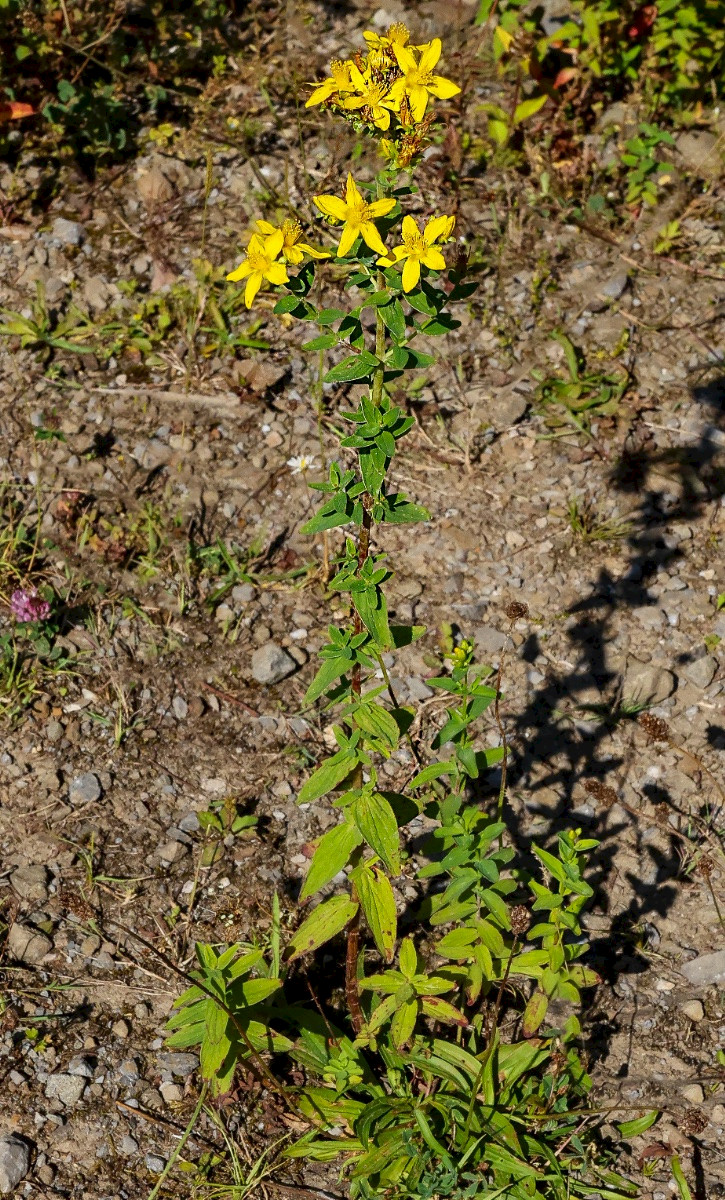
Hypericum x desetangsii - © Charles Hipkin
Lamotte
A spontaneous, fertile hybrid (2n=32) which is found throughout Britain in verges, rough grassy places, coal tips, railway banks and waste places. The first record and discovery of this hybrid was from railway ballast in Aberystwyth, Cardinganshire (VC46) in 1974 (see Arthur Chater's Flora of Cardiganshire). It is a tall, rhizomatous perennial which is usually intermediate in its morphology between its parents, Perforate St John's-wort (Hypericum perforatum) and Imperforate St John's-wort (Hypericum maculatum). The square stems usually have two obvious ridges like Perforate St John's-wort, but also two faint ridges and the leaves usually have some translucent dots, sometimes few, a character that will separate it from Imperforate St John's-wort. One of its most important distinguishing feature is the shape and form of the sepals, which are lanceolate (usually narrower than those of Imperforate St John's-wort) with a distinct apical point and small, irregular teeth just below the apex. Bumblebees visit the flowers and those of its parents eagerly and back-crossing between the hybrid and its parents is believed to be common. Consequently, although the hybrid often occurs in the absence of both parents, a significant amount of genetic introgression can take place in mixed populations, where one or other are present. It is usually closer in its overall morphology to Imperforate St John's-wort and confusion between the two is easy. It is common in rough grassy verges and roadside verges along forest roads in West Glamorgan and it is possible that most records of Imperforate St John's-wort in West Glamorgan are in fact misidentifications and should be attributed to Desetang's St John's-wort.
Native (perhaps endemic)


