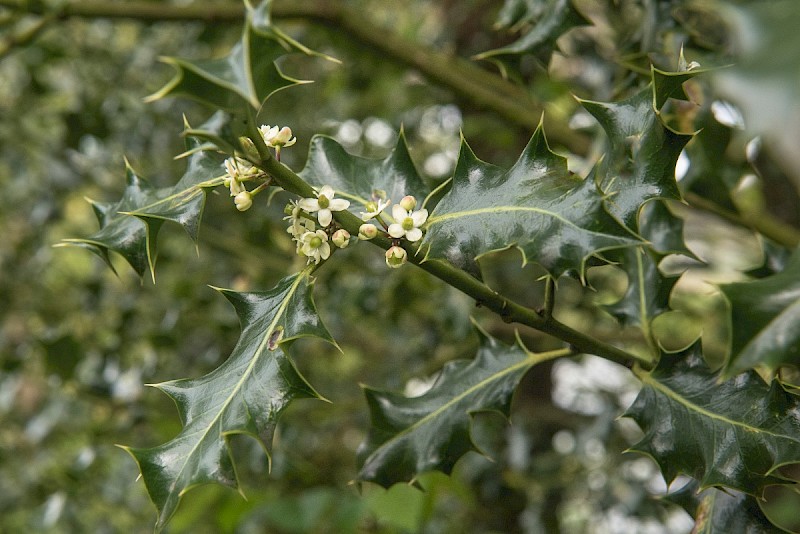
Ilex aquifolium - © Charles Hipkin
Linnaeus
An evergreen shrub or tree of woodlands and hedgerows with glossy, wavy, dark-green leaves which are usually armed with spines. The small, fragrant, white, four-petalled flowers that are produced in late spring through to summer attract lots of pollinators, particularly honey bees, bumblebees, solitary bees and hoverflies. Individuals are either male or female, so cross pollination is essential for fruit production. The familiar red berries are only produced by females which are most productive in well-lit habitats, such as hedgerows, parks and gardens where they grow into compact shrubs and trees. Hollies in shady woodland are often much more leggy and produce few or no berries. The berries are eaten by lots of frugiverous birds such as thrushes and wood pigeon that disperse the seeds, which germinate readily. Holly is a suboceanic species and is a familiar component of Atlantic woodland in the west of Britain. It does best where the winters are mild and relatively frost-free, but, nevertheless, it is found throughout Britain and Ireland. It is abundant and ubiquitous in Wales and it is common and widespread througout West Glamorgan. Although it is undoubtedly native in the county and a frequent component of Sessile-oak woodland, it is also widely planted. It responds well to coppicing, producing vigorous new shoots which grow into multi-stemmed trees whch become large trees. Holly trees can live for 200 years or more and a few veterans are known in West Glamorgan (see photo). Young holly leaves are quite soft and palatable to domestic livestock and deer. Pollarded holly trees were grown in groves to provide a source of winter fodder for livestock in the past. Such places were known as 'hollins' and this word is used occasionally for place names in the local countryside, e.g. The Hollins in Cimla, Neath Port Talbot.
Native (but also planted)


Key: