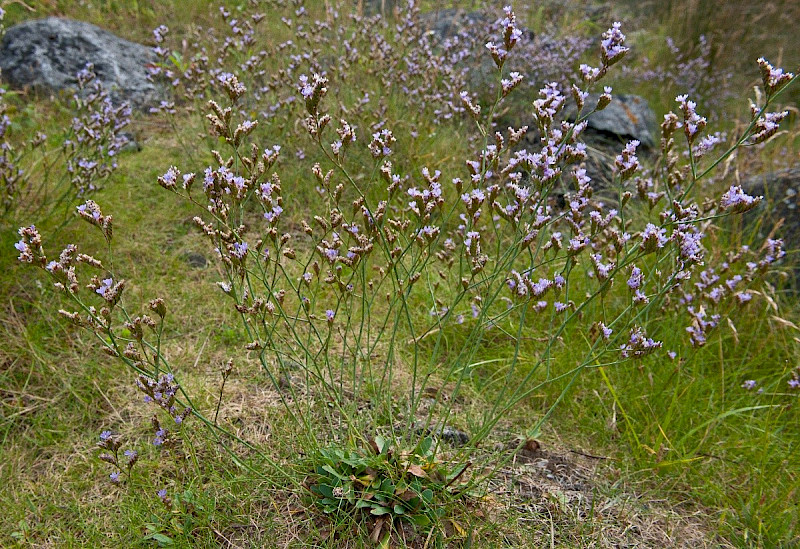
Limonium procerum subsp. procerum - © Charles Hipkin
Rock sea-lavenders (Limonium binervosum agg.) are a complex group of apomictic perennials. In his New Flora of the British isles (4th edition, 2019), Clive Stace provides a multi-access key to 9 taxa in this aggregate of which only Limonium procerum ssp. procerum occurs in West Glamorgan.
It is a relatively tall plant (25- 50cm or more in height), more slender than Common Sea-lavender (Limonium vulgare) with smaller leaves that have up to 3 unbranched veins and straight branches more or less confined to the upper half of the stem. It is largely confined to the west coast of Britain from Devon to north Wales, with an outlying cluster in the south of England. It is very common along the coast of south Wales on sea cliffs, the upper parts of salt marshes and in the transition zone between salt marsh and sand dune. It is a common coastal plant in West Glamorgan, particularly in Gower and around the coastal edges of Swansea Bay, including Crymlyn Burrows, Bagland Dunes and the lower Neath estuary. Large populations in flower can provide spectacular displays of lavender in summer.
Rock Sea-lavender is the larval host plant of the Cliff Plume Agdistis meridionalis, listed as Nationally Scarce A. Perculiarly, this moth sits with its wings held up above its head, each wing being rolled up to appear twig-like. It is a reluctant flier and therefore not very easy to find. The larvae can be found by diligent searching of the most exposed plants on the cliff, possibly where there is less competation, or where the plants are more stressed. Interestingly the moth is onlly found on plants growing on cliffs, but not those in sand dune or saltmarsh habitats.
Native (endemic)


Key: