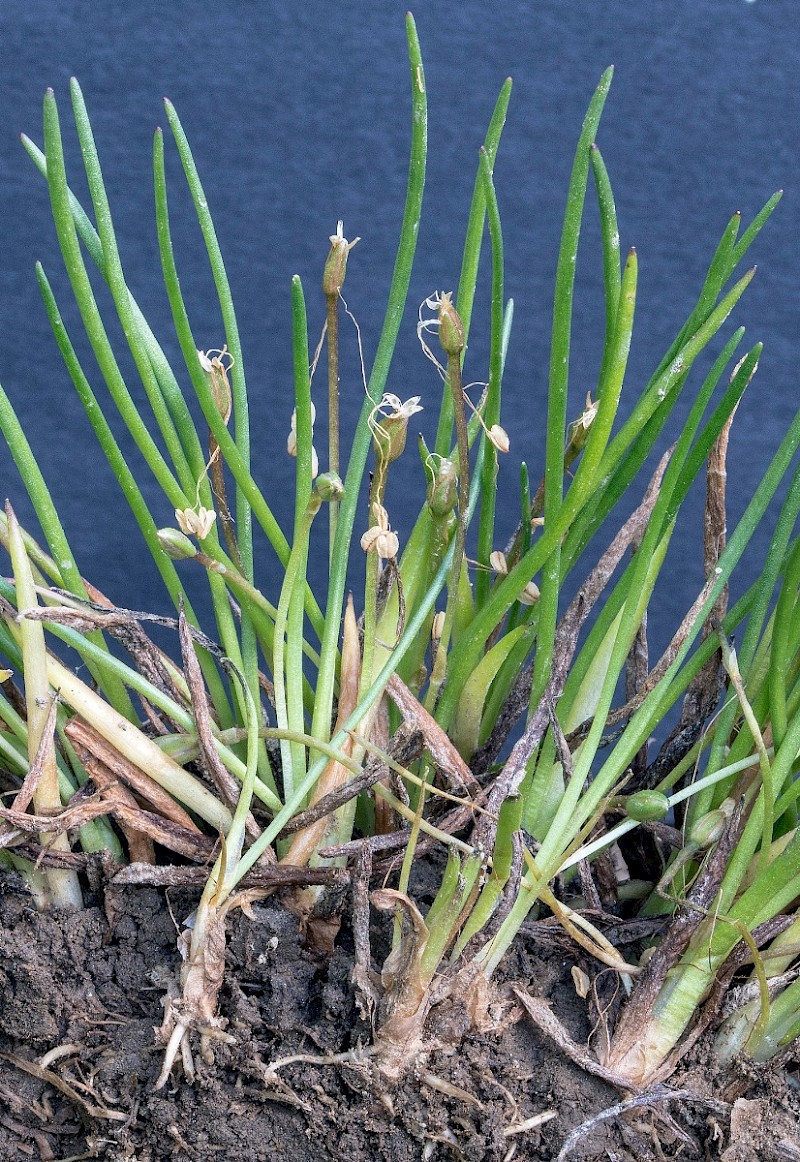
Littorella uniflora - © Charles Hipkin
(Linnaeus) Asch.
An amphibious, aquatic perennial which is a member of the plantain family (Plantaginaceae). It grows in, and at the edges of, acidic, oligotrophic lakes and mesotrophic pools, such as tarns, lakes, reswrvoirs. ponds and winter-flooded habitats, where it produces tufts of semi-cylindrical leaves that are flat on one side and rounded on the other. In transverse section a cut leaf can be seen (with a hand lens) to have lots of small, hollow gas channels (compare with Isoetes species and Lobelia dortmana). It often forms large swards that form a lawn which may be submerged or become terrestrial when water levels recede in the drawn-down zone. It is monoecious producing separate, greenish male and female flowers, on the same plant. Each plant produces a single, long-stalked male flower with conspicuously long stamens and female flowers which are formed at the base of the shoots. Shoreweed is wind pollinated and seeds, which remain viable for many years, are dispersed in water currents and also by waterbirds. In addition, vegetative spread by stolons helps to build large clonal colonies. Shoreweed is a Suboceanic species with a western and nortern distribution in Btitain. It is widespread and locally frequent in many parts of Wales but with just a few scattered records in West Glamorgan where it occurs in oligotrophic lakes such as Llyn Fach and in reservoirs and ponds in Margam and in the Gnoll Estate Country Park in Neath. It often grows in deep water and its occurrence may only become apparent when water levels fall appreciably. It is probably under recorded in the county.
Native
Shoreweed is morphologically similar to quillworts (Isoetes species) and Water Lobelia (Lobelia dortmanna), which also share its physiological, isoetid stategy where carbon dioxide is assimilated via the roots from aquatic sediments and then transported via gas channels (see photo) to the leaves where it is used in photosynthesis (see description of Water Lobelia).


Key: