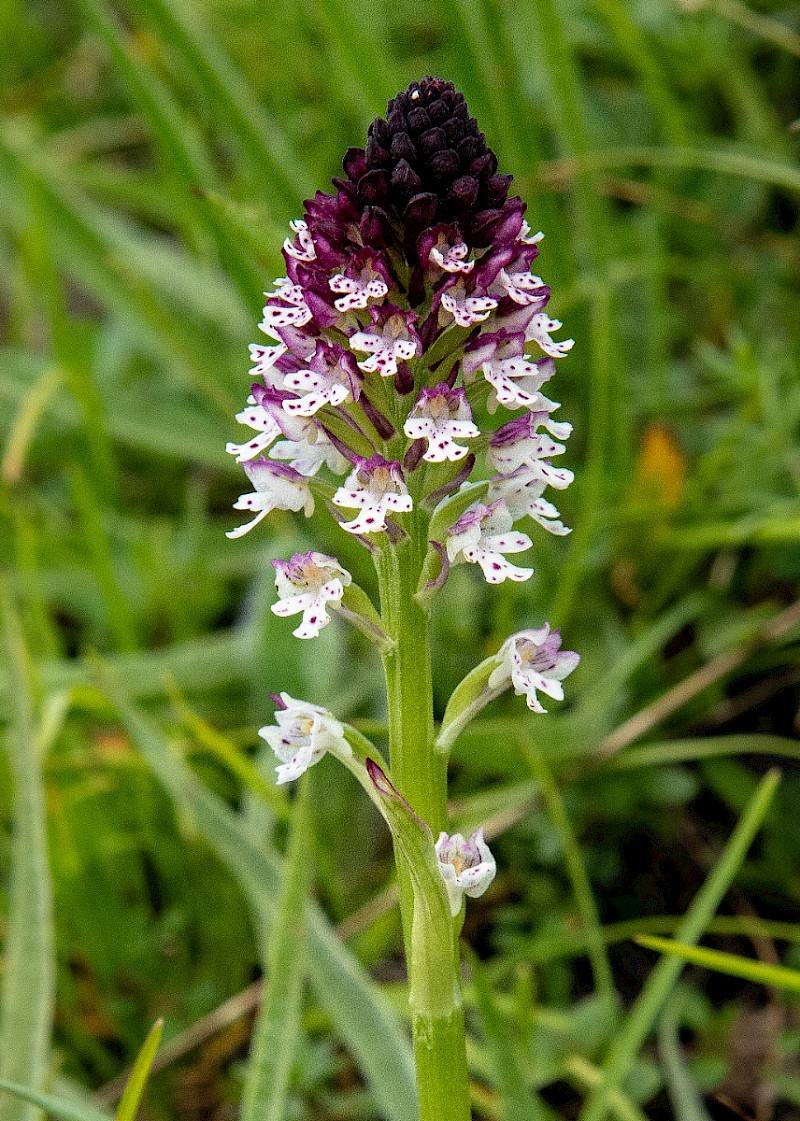
Neotinea ustulata - © Charles Hipkin
(L.) R.M.Bateman, Pridgeon & M.W.Chase
A tuberous perennial which grows in calcareous soils on chalk or limestone, particularly on grazed, south-facing slopes which are warm and dry. It is largely a southern species in Britain which has been lost from many of its former sites as a result of changes in agricultural magement and lack of adequate grazing. It is unmistakable when it has its cylindrical spike of white, spotted flowers with dark maroon hoods, which at the tip of the spike are clustered tightly together giving the dark, burnt-tip appearnace from which it gets its name. Two forms occur in Britain, a short form which grows 5-10cm tall and flowers in May and a tall form, 8-15cm tall, which flowers in July and August. It is not found in Ireland and is absent from Wales and western Britain except for a single, remarkable occurence in limestone grassland in Gower.
Native


Key: