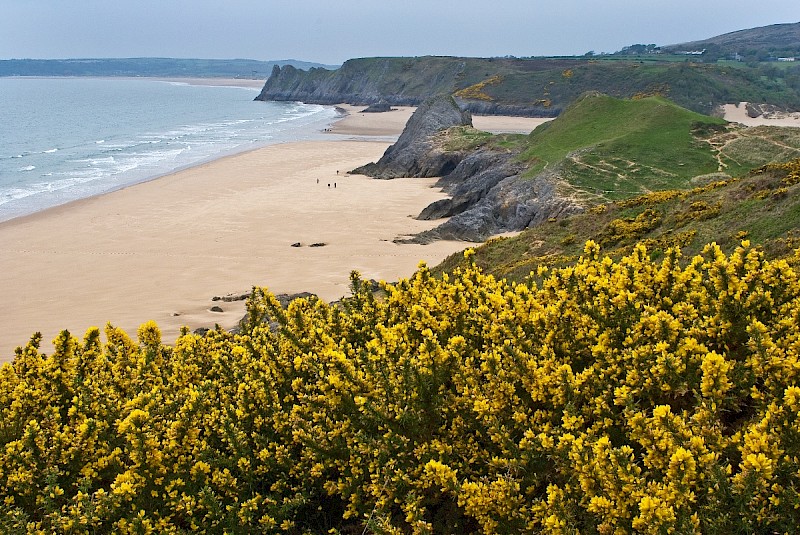
Ulex europaeus - © Charles Hipkin
L.
A thorny, Oceanic-Temperate shrub which is common and widepread thoughout Britain. It grows on mildly acidic or base-rich soils such as coastal cliffs, heathland and roadsides, often in abundance on south-facing slopes. It flowers prolifically in late winter through to early summer producing masses of yellow peaflowers which have a coconut-like smell. Ants play an important role in the dispersal of its seeds. It is common and widepread throughout West Glamorgan and abundant on the south Gower cliffs and in well-drained heathland in The South Wales Coalfield. It also grows in open mosaic habitats, including coal tips. Western Gorse (Ulex gallii) is similar but usually smaller and flowers later in the year from mid-summer through to autumn. They differ also in their thorns, those of Common Gorse being larger, distinctly ridged and furrowed and often slightly curved. It can dominate large areas of cliff habitat, heathland and areas important for grazing, sometimes to the detriment of scarce species of conservation concern. However, gorse cover is also important for invertebrates, reptiles and breeding birds such as Linnet and Dartford Warbler. It is able to withstand burning, so although eradication by burning is common it only provides a temporary solution.
Native


Key: