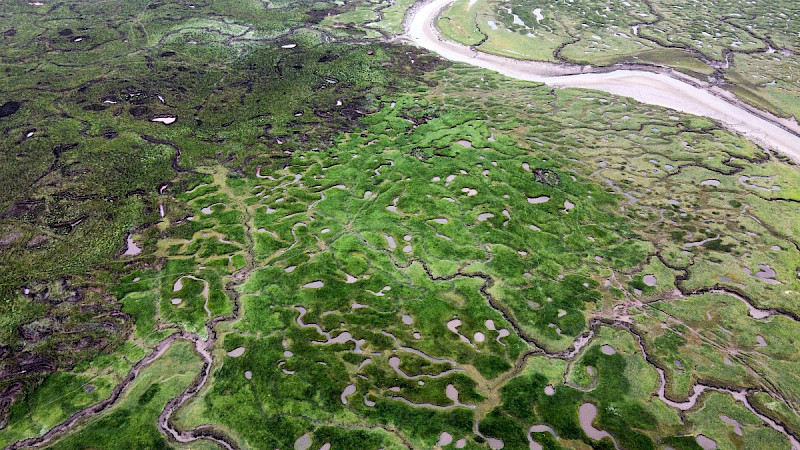
Saltmarsh - © Barry Stewart
Saltmarshes are maritime, wetlands formed along sheltered tidal inlets and estuaries that are flooded periodically by seawater with low wave energy, which favours the gradual acretion of muds and sediments. It is a land-building ecosytem which can be conveneiently divided into three distinct zones: the lower marsh which is subject to inundation by sea water twice a day throughout the year, the middle marsh, which is inundated less frequently depending on the size of the tide and the upper marsh which is only inundated by the highest tides. The tidal cycle is an extremely important determinant in the ecology of saltmarshes where the reach of the tide varies with both the monthly lunar cycle and the seasons. The highest tides, which cover all the marsh, occur at and around the times of the spring and autumn equinox. This variation in tidal flooding is the main determinant of saltmarsh zonation and it is reflected in the successional pattern of vegetation, plant diversity and physiological ecology.
Daily inundation with seawater in the low marsh creates an extreme, salty environment which can only be tolerated by a few pioneer, annual, halophytic species such as Glasswort (Salicornia spp.) and Seablite (Suaeda maritima) and bare mud there is frequently colonised by Cord Grass (Spartina spp.). Sheltered estuaries may also have significant beds of Eelgrass (Zostera species). A number of Glasswort species occur on British saltnarshes, of which Salicornia dolichostachya is the one which occurs in the lowest parts of the marsh, while other species of Glasswort may be found as pioneer species on bare mud in the middle marsh where Seablite is also found.
The middle marsh is more diverse in halophytic species, often very large in extent and usually dominated for the most part by Saltmatsh Grass (Puccinellia maritima). Other species such as Sea Purslane (Atriplex potulacoides), English Scurvy-grass (Cochlearia anglica), Sea Arrow-grass (Triglochin maritima), Sea Plantain (Plantagp maritima), Sea Spurry (Spergilaris media), Sea Lavender (Limonium vilgare) and Sea Aster (Aster tripolium) are usually significant features of ungrazed marshes. Saltmarsh Grass is gradually replaced by the salt-tolerant ecotype of Red Fescue (Festuca rubra) in the upper reaches of the middle marsh and as this zone transitions to the upper marsh, species like Sea Milkwort (Glaux maritima), Thrift (Armeria maritima), Sea Rush (Juncus maritimus) and Saltmarsh Rush (Juncus gerardii) are often abundant and conspicuous. The distinction between middle and upper marsh in this part of the saltmatsh is often complex.
The upper marsh, which is brackish but rarely inundated with seawater, often supports a very diverse flora, especially where habitats transitional with sand dune or freshwater marsh are present.


