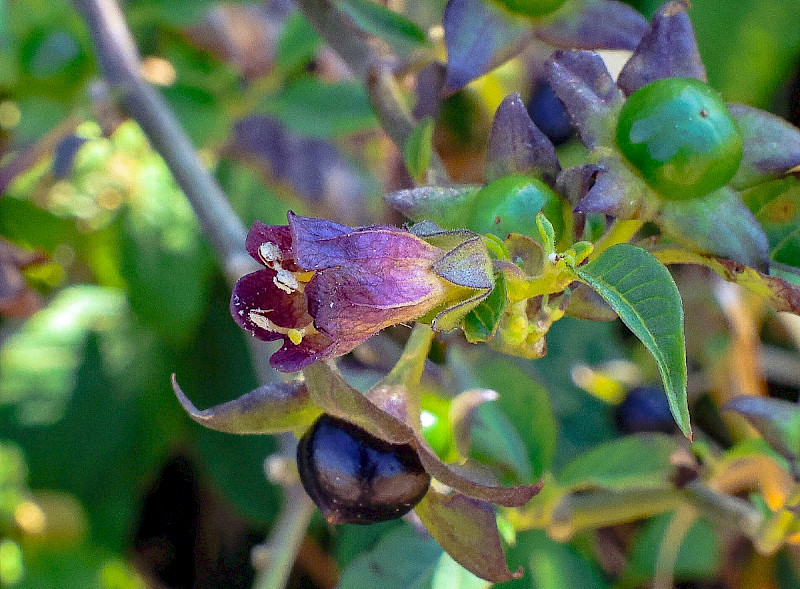
Atropa belladonna - © Charles Hipkin
L.
A large, much branched, bushy, herbaceous perennial which grows up to 2m or more in height, with broadly-oval, pointed leaves and often a sprawling habit, found in hedges, scrub, fields and open woodland. It produces purple, bell-shaped flowers in summer each of which gives rise to a conspicuous black berry surrounded by five sepal lobes. It is largely a species of south and central England where it is native on soils formed on chalk or limestone. It is scarce in Wales and some (perhaps most) plants here are introductions. It has decreased markedly in some parts of the country and is on the rare plants registers of many vice counties, including Glamorgan (VC41) where it is known from Penarth and the Vale of Glamorgan whose populations may be ancient introductions. It was once known in West Glamorgan from Mumbles and Oystermouth Castle but was deliberately eradicated. All parts of Deadly Nightshade contain very toxic tropane alkaloids, notably atropine amd scopalamine. They interact with acetylcholine receptors and interfere with the transmission of signals between nerve cells, thus blocking the parasympathetic nervous system. Both atropine and scopalamine have medical uses. Scopalamine is sometimes prescribed to prevent motion sickness (appled in a patch) and also to prevent vomiting that occurs with patiens after anaethetic has been used in surgery. Atropine is used to treat slow heart rates and to reduce body secretions that can occur during surgery. It is also used as an antidote to poisoning by organophosphate insecticides and certain nerve agents. Atropine eyedrops are also used to dilate the pupils of the eye which is required in some eye examination procedures. Deadly Nightshade is also known as Belladonna (meaning beautiful lady) and extracts from it were widely used by ladies in Renaissance times to dilate their pupils and make their eyes more attractive. British apothecaries and physicians collected Deadly Nightshade from the wild and grew it for its medical properties from the late Middle Ages onwards. Some plants now wild in Britain could have been derived from old physic gardens.
Native (but psoossibly acgaeophyte or neophyte in some places)


