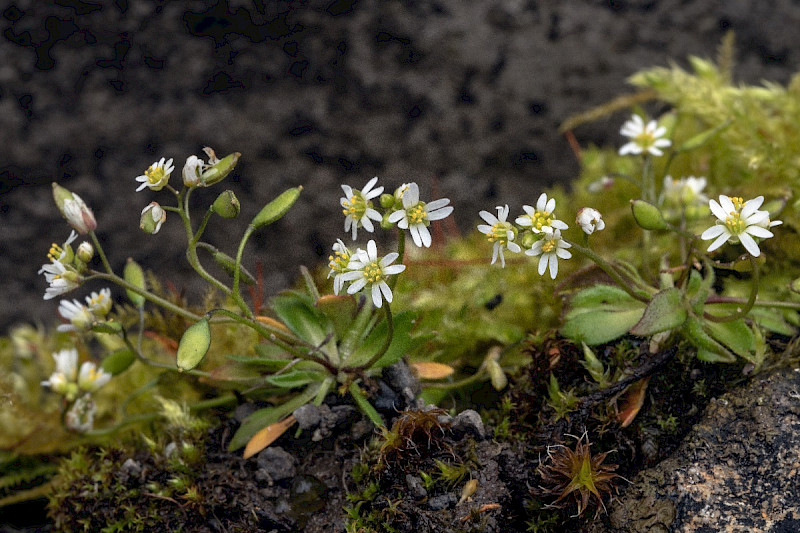
Erophila verna - © Charles Hipkin
(L.) DC.
A small, white-flowered winter annual which grows in dry, calcareous habitats such as sand dunes, calcareous cliffs, stony and gravelly habitats and urban skeletal habitats such as walls and pavements. Rosettes of hairy lanceolate leaves give rise to shoots in early spring that produce flowers with 4 deeply notched petals. Although the flowers are sometimes visited by insects they are self-fertile and self pollination is a very important reproduction strategy for this species. The seed capsules produced after fertilisation are elliptical, flattened and rather dark in colour. It is a very common plant in Britain occuring throughout Britain and Ireland. It is common in coastal areas of West Glamorgan, often growing with other winter annuals like Rue-leaved Saxifrage (Saxifraga tridactylites). It has a more scattered distribution inland in the South Wales Coalfield where it is often found as a pavement weed in valley towns and villages and occasionally in the well drained calcareous gravel edges along forest roads.
Erophila verna (sensu lato) is now regarded as a complex segregate of species that includes Erophila verna (sensu stricto), Erophila majuscula and Erophila glabrescens. All of these have been recorded in West Glamorgan but Erophila verna s.s. is the most common and widespread taxon. Erophila verna s.s. ( 2n=30-46) and Erophila glabresens (2n=48-56) are both polyploid taxa while Erophila majuscula i(2n= 14) is diploid.
Native


Key: