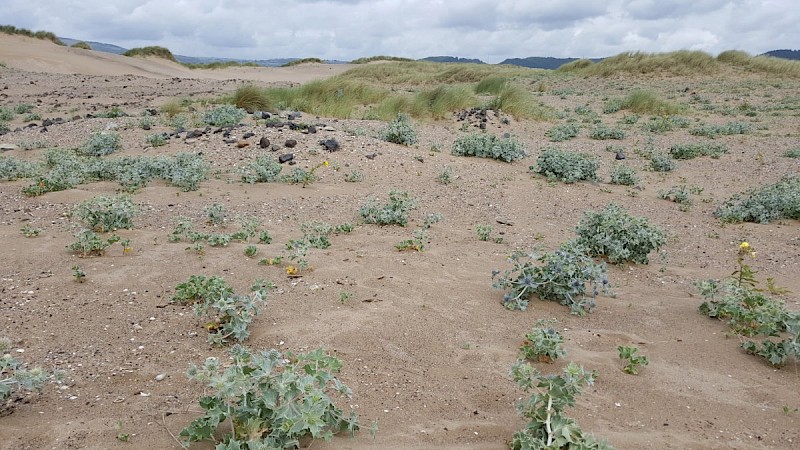
Eryngium maritimum - © Barry Stewart
L.
An unmistakable, bluish-green perennial with spiny leaves and globular heads of pinkish fowers in summer. Plants often take on a deeper bluish hue in the midst of the summer flowering season when it becomes a strikingly beuatiful plant. It is a species of coastal habitats, particularly sand dunes where it grows in open, semi-fixed habitats typified by the SD4 (National Vegetation Community) assemblage that also contains species like Marram Grass (Ammophila arenaria), Sea Spurge (Euphorbia paralias), Sea Stock (Matthiola sinuata), Dune Fescua (Vulpia fasciculata), Sand Cat's-tail (Phleum arenarium) and Sand Sedge (Carex arenaria). It is also found occasionally in maritime shingle, but it is otherwise confined to coastal sand dunes throughout its European southern temperate range. It is found on all the main sand dune systems of West Glamorgan but the largest populations are in the sand dunes of Neath Port Talbot, many of which still have significant areas of dynamic, open sandy habitats. Its conservation status in Britain is designated as red, but of least concern. Nevertheless, Sea Holly has disappeared from many of its sites, particularly along the northeast coast of Britain and it has also suffered significant losses in other parts of its European range. Increasingly, in areas where it survives, populations are dwindling and represented by few individuals. Habitat destruction and loss of open sandy areas on dunes that have become increasingly fixed through natural succession are some of the reasons why this is happening. Plants contain a diversity of secondary metabolites, particularly phenolic compounds, triterpene saponins, flavonoids and essential oils. When Sea Holly callus extracts have been tested for their efficacy in skincare, there have been promising results. The fleshy roots, which smell like carrots or parsnips, have been eaten traditionally as candied eryngoes.
Native


Key: