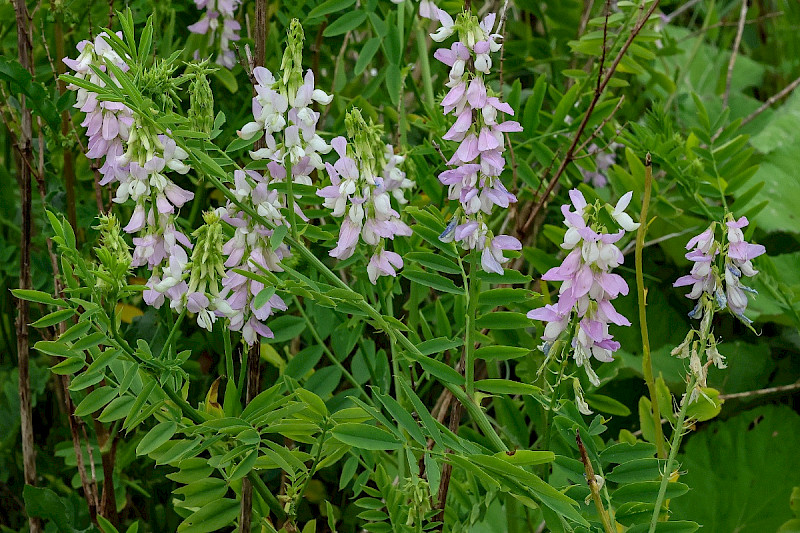
Galega officinalis - © Charles Hipkin
Linnaeus
A large, sprawling and often bushy perennial with pinnate leaves which produces elogated clusters of pale blue or violet pea-flowers in summer. It was introduce to and cultivated in Britain from the late 16th Century and was first recorded wild in Britain in the Cambridge area in 1640. It has spread significantly in recent decades, paerticularly in the southeast of England where it grows along railways, on wayside banks and in waste places, mostly in urban areas. More recently it has began to expand its range into rural landscapes and has extended its range westwards. It is absent or uncommon in much of Wales except for the southeast, including East Glamorgan, where it has become a familiar sight in docklands, urban waste places, roadsides and railways. It is not as common in West Glamorgan, where there are scattered records, but it is being recorded in new sites almost every year. The sterile hybrid (Galega x hartlandii) between Goat's-rue and Oriental Goat's-rue (Galega orientalis) is grown as a garden plant and is a possible source of confusion for recorders, but unlike its parents it does not produce viable seed. The status of this hybrid is unknown in West Glamorgan at present. Goat's-rue has had a long tradition in folk medicine and was administered by apothecaries as a hebal tonic and also used in the treatment of bubonic plague in the Middle Ages. It is know to contain biguanide substances, e.g galegine and guanidine, which reduce blood sugar levels but neither are suitable as antidiabetic drugs due to their adverse effects on human physiology. However rerseach into the pharmacological effects of galegine have led to the development of more effective antidiabetic drugs.
Neophyte


Key: