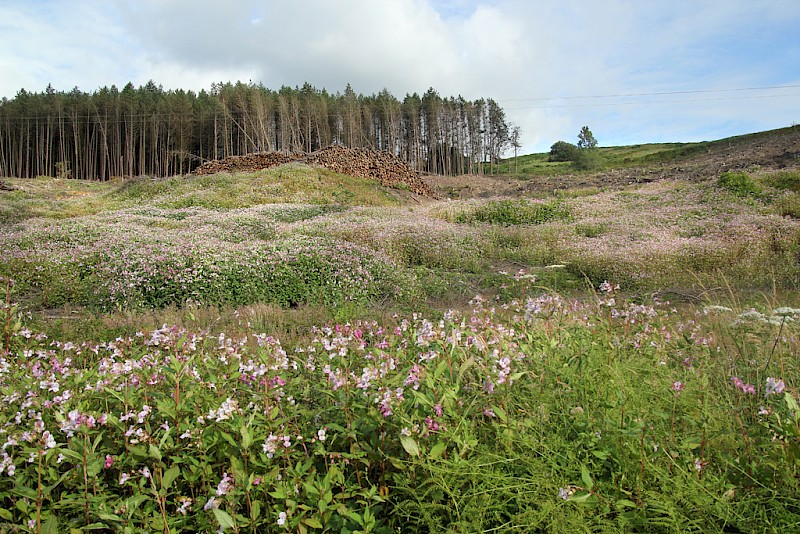
Impatiens glandulifera - © Barry Stewart
Royle
Perhaps better known to most as Himalayan Balsam, it is a notorious invasive non-native species (INNS) and the tallest annual in the European flora. It is native to the Western Himalaya where it grows in damp areas, often along rivers and in foothill forests. It was first introduced to Britain as a garden plant in 1839 and recorded in the wild, in Middlesex, in 1855. It sometimes grows to be as much as 3 metres tall and may produce buttress-like structures at the base of the stems to give added support to its hollow shoots. Seedlings emerge with a large pair of cotyledon leaves in early spring (see photo) and grow rapidly during late spring and early summer before flowering. The zygomorphic, helmet-shaped flowers are usually pink but vary from almost white through to a rich magenta colour. In Britain, it grows well in riparian habitats such as on the banks of water courses, as well as in damp grasslands and verges and in woodland, but not commonly under conifers. It is moderately shade-tolerant and although it will grow in open, sunny locations it seems to prefer at least slightly shaded habitats and it often performs poorly in open sites that are exposed to prolonged sunny weather in summer. For example, large populations sometimes invade recently clear-felled areas in forestry but rarely survive more than 1 or 2 growing seasons. Populations are usually very large and under favourable conditions flower production is prolific and their peach-like scent can be very noticable. The fowers are visted by lots of different pollinators, particularly bees and flies and large populations produce huge amounts of seed which is ejected explosively up to 5m in distance by the touch-sensitive pods. These seeds may be further dispersed by people, vehicles, mountain bikes and in water. Most of the seeds germinate in the first growing season after dispersal and rarely remain viable after 2 (to 4) years. Consequently, there is no long-lived, persistent soil seed bank and local populations can be eradicated if a prologed and consistent strategy of removal before plants begin to flower is employed over a 2 to 3 year period. Some systemic herbicides such glyphosate have also been used to control it and grazing by livestock can be effective early in the growing season but sheep and cattle may avoid grazing it later in the season; goats appear to be less fussy!. It is found throughout Britain except for the highlands of Scotland and it is absent from much of central Ireland. It is common in most of Wales and it is widespread in the lowlands and watersheds of the main valleys of West Glamorgan but is rare or absent from the coniferised uplands and absent from much of Gower.
Neophyte


Key: