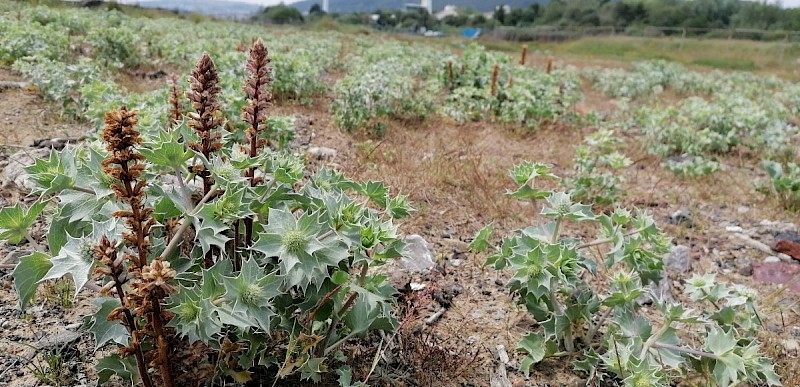
Orobanche minor - © Barry Stewart
Smith
Orobanche minor, Common Broomrape, is the most common Broomrape in Britain. It, has an extremely wide host range but it is associated commonly with legumes (Fabaceae), composites (Asteraceae) and umbellifers (Apiaceae). In West Glamorgan It is common and often abundant in coastal areas, on or near sand dunes, where it mainly parasites Sea Holly (Eryngium maritimum), Common Cat's-ear (Hypochoeris radicata) and Restharrow (Ononis repens), but also other species and sometimes an individual will form haustorial connections with more than one host (Hipkin, C.R. (1992) Watsonia 19, 107-112) The following infraspecific taxa have been identified in our area: Orobanche minor Subsp. minor var. heliophila; Orobanche minor Subsp. minor var. pseudoamethystea; Orobanche minor forma lutea (= Orobanche minor var flava). The form associated with Sea Holly is assumed to be var. pseudoamethystea. Forma lutea is a very striking yellow form which grows occasionally with the common purple form (see photo). Orobanche minor can be confused with Orobanche hedereae but it usually has pink stigma lobes (see description of Orobanche hederae, which has yellow stigmas). Note however that forma lutea has yellow stigmas but does not resemble Orobanche hederae in other respects.
The status of Common Broomrape in Britain is uncertain. Throughout most of its range, where it grows commonly on clovers, it may be an alien. However, plants that occur in coastal locations in sand dune communities (e.g. var. pseudoamethystea) may be native.


Key: