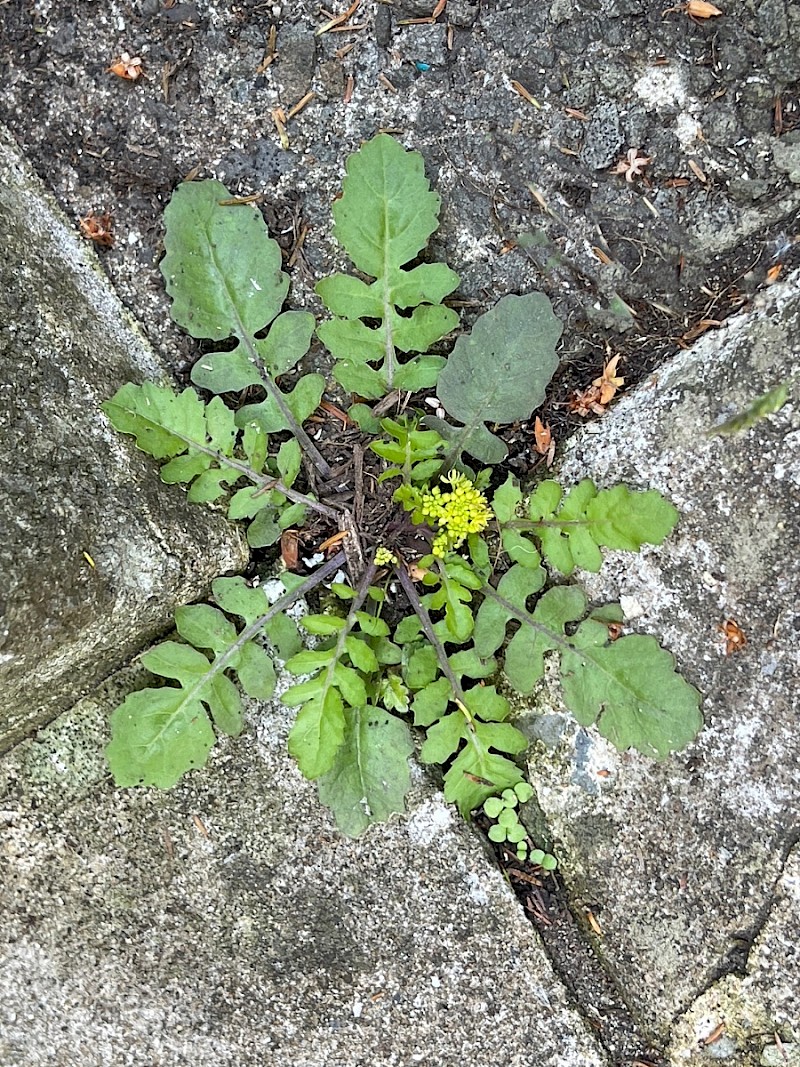
Rorippa islandica - © Charles Hipkin
(Oeder ex Murray) Borbas
Like Marsh Yellow-cress (Rorippa palustris), Norhern Yellow-cress has small yellow flowers and pinnately lobed leaves, but the growth form is predominantly prostrate and sprawling and the fruit capsules are 2-3 as long as their stalks. The mature fruits tend to point downwards and they become orientated to one side of the flowering stems. The critical difference between them is in their chromosome numbers; Northern Yellow-cress is diploid (2n=16) whereas Marsh Yellow-cress is tetraploid (2n=32). They also differ in the microscopic surface structure of their seeds. Separating the two species in the field can be difficult and some authorities maintain that they can only be named with confidence after chromosome counting. We have named specimens Rorippa islandica if they clearly show the characteristic fruit structure and configuration described above (see photo). It grows in wet or muddy places near water bodies and increasingly in waste places. It is less common than Marsh Yellow-cress in Britain but it is not as rare as once thought and it may be spreading via colinisation of urban waste places. South Wales appears to be a hot spot for it and there are scattered records in West Glamorgan, particularly in Neath Port Talbot.
Native


Key: