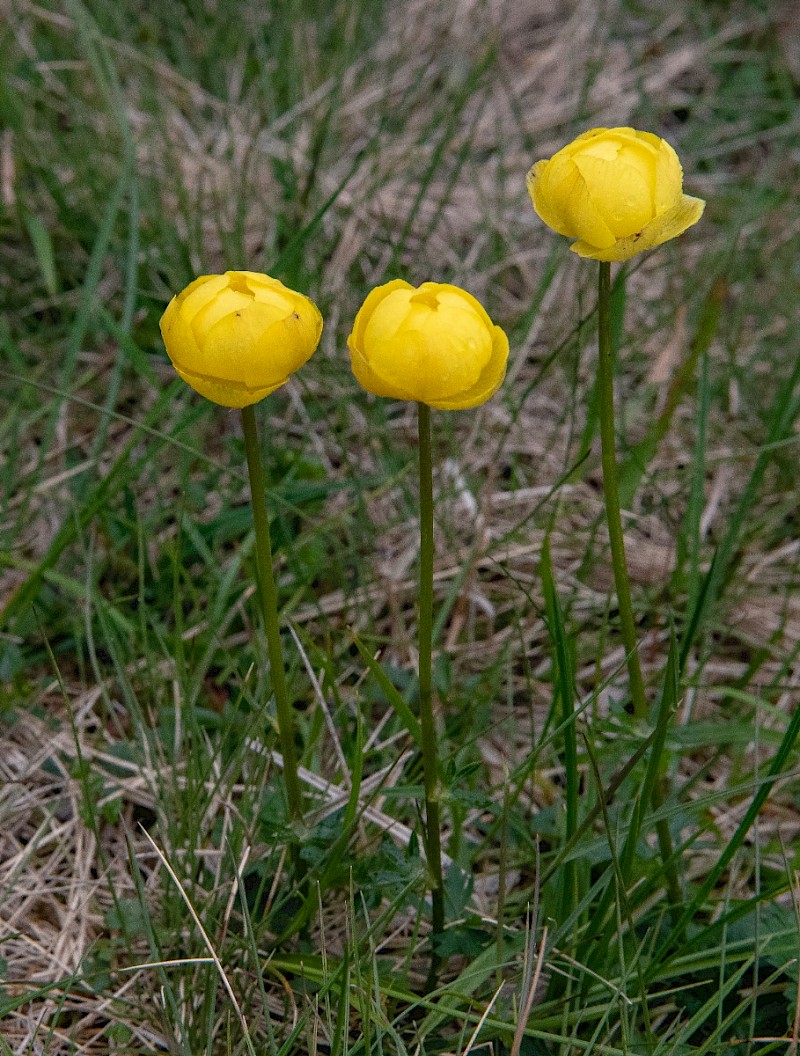
Trollius europaeus - © Charles Hipkin
Linnaeus
A hairless, perennial herb with deeply cut, palmate leaves which look a little like those of Meadow Buttercup (Ranunculus acris) or Meadow Cranesbill (Geranium pratense). It is unmistakable when it produces its almost spherical, orb-like, yellow flowers, which remain tightly closed at night. It is an upland species of wet meadows and marshy grasslands especially where there is base-richness, streams and riverides, lake margins and open woodland, largely confined to the west and north of Britain. Although it is widespread within its British range it has declined greatly in many areas, particularly at the southern edge of its range in Wales, mainly as a result of agricultural improvement, drainage, late successional changes in unmanaged grasslands and perhaps overgrazing. It was relatively scarce and rather local in Glamorgan even during the earliest periods of reliable recording although John Storrie noted that it was frequent in Ely, Taff and Rhymney valleys of East Glamorgan in the late 19th Century. William (Weston) Young mentions the occurrence of Globe Flower in the Vale of Neath in his Guide to the Scenery &c of Glyn-Neath (1835) and in his Materials for a Fauna and Flora of Swansea and the neighbourhood (1848) Lewis Weston Dillwyn mentions its occurrencein the Pyrddin and Dulais valleys of West Glamorgan, where it was still known by CH at the end of last millenium. It has not been recorded anywhere in the county in more recent decades.
Native


Key: