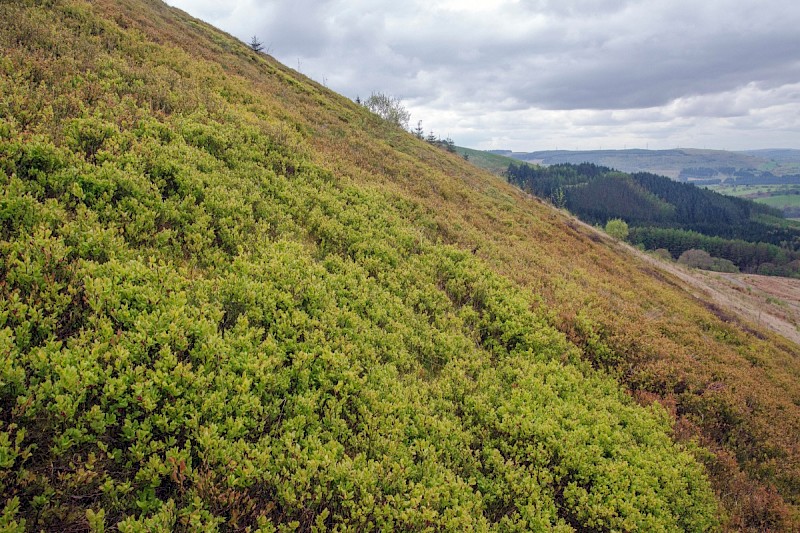
Vaccinium myrtillus - © Charles Hipkin
L.
A hairless, rhizomatous, semi-deciduous sub-shrub with ridged stems and oval, pointed leaves. It is a calcifuge which grows on acidic soils on heathland, moorland, peat bogs and in both deciduous and conifer woodland. In all these habitats it can form large, clonal colonies, often dominanting the ground (see photo). Although it is common and widespread in much of Britain, it is absent from most of the south east of England where it has disappeared from lowland heathland largely through habitat destruction. It produces lots of drooping, greenish-pink flowers, particularly in unshaded habitats, which give rise to a small, delicious black berry. In some parts of the country it is known as whinberry and also as whortleberry, among other names. The fruits are consumed by frugivorous birds and small mammals which must play a part in seed dispersal but, apparently, new plants rarely arise from seeds. It is common in West Glamorgan, particularly in the South Wales Coalfield but less so in Gower away from the Commons.
Invertebrates associated with Bilberry are many and examples of some less common species recorded within West Glamorgan include Beautiful Snout Hypena crassalis (Local), Bilberry Pug Pasiphila debiliata (Nationaly Scarce), Dusky Knothorn Matilella fusca(Local).
Native


Key: