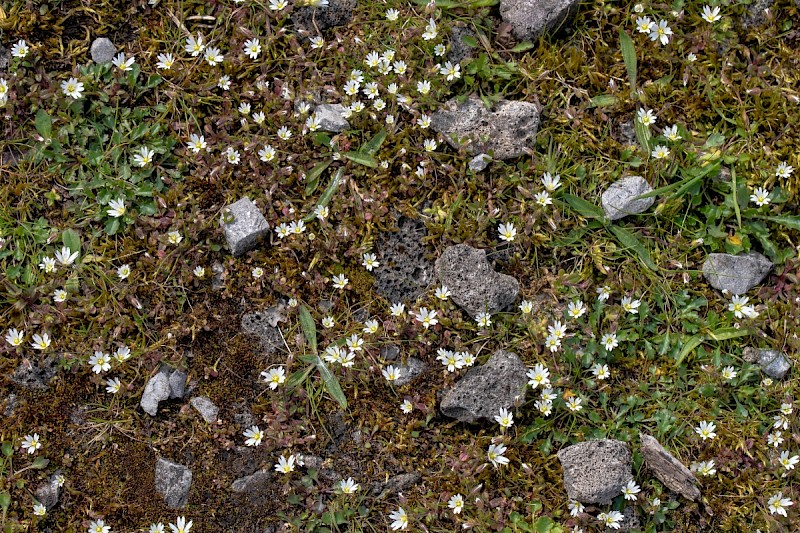
Cerastium pumilum - © Charles Hipkin
Curtis
Dwarf Mouse-ear is an early-flowering, glandular-hairy annual of dry, calcareous habitats. It is represented in the British flora as Cerastium pumilum subsp. pumilum, which has its main distribution in western Europe but has undergon a significant decline in Britain where it is rare with a very scattered distribution. It is extremely rare in Wales and was discovered new to Glamorgan and south Wales by CH in 2023 in dry calcareous grassland near Margam Moors and along part of the railway line nearby. Shortly after, BS discovered a population on Morfa Dunes and in 2026 a significant population was noted there by Dan Black and CH. Although populations are striking in flower, it could be passed-over for other more common Cerastium species. In its habit it is somewhat similar to Sea Mouse-ear (Cerastium duffusum) but the flowers are larger, more conspicuous and they have 5 petals and 5 sepals. It is also similar to Common Mouse-ear (Cerastium fontanum), which is a perennial, but the stems and sepals of Dwarf Mouse-ear are covered in glandular hairs. The West Glamorgan populations have very showy flowers whose bifid petals are a liitle longer than the sepals. The status of this species in Glamorgan is debatable, given that populations on railway ballast in Bedfordshire are usually regarded as neophyte. However, its occurrence on Morfa Dunes suggests that it may be native here.
Native


Key: