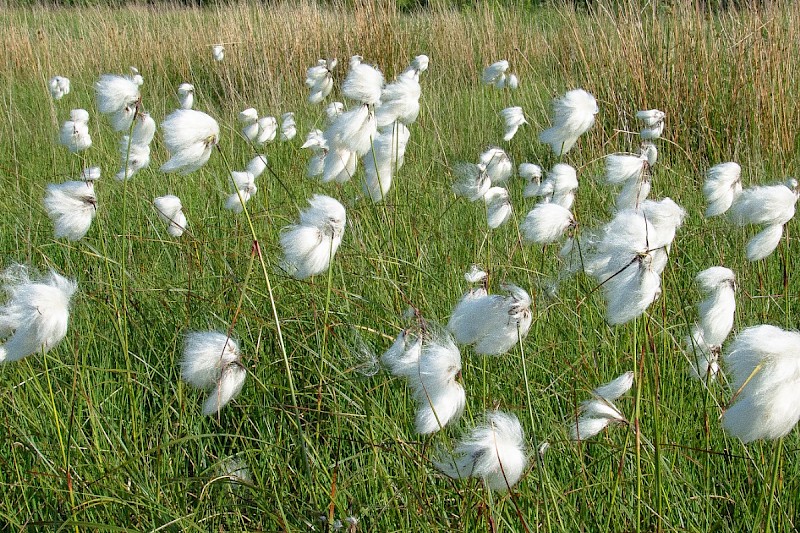
Eriophorum angustifolium - © Charles Hipkin
Honck.
A perennial, rhizomatous sedge which grows on wet peaty ground in bogs and mires, wet heathland, moorland and marshy grasslands, usually in acidic soils but also in calcareous flushes. The long, grooved leaves (2-6mm wide) are narrowed to a solid, three-sided point at their tips. Three or more drooping spikelets of small flowers with yellow anthers are produced in spring and these give rise to the more conspicuous and familiar heads of white, cottony fruits in summer, from which it gets its common name. It can grow in quite dense, showy, white stands in boggy ground (see photo) and then it is easy to see from a distance. It has a circumpolar boreal distribution and is widespread and common in suitable habitats in the west and north of britain but has been lost from many parts of lowland England where it is now scarce. It is the most common cottongrass in West Glamorgan and a conspicuous feature of the Gower Commons. It is also frequent in the uplands of the South Wales Coalfield on wet, peaty moorland and in marshy, Purple Moor-grass (Molinia caerulea) grasslands. It is also found in fenland, such as Crymlyn Fen and there was a significant population in dunes slacks on Crymlyn Burrows in previous decades.
Native


Key: