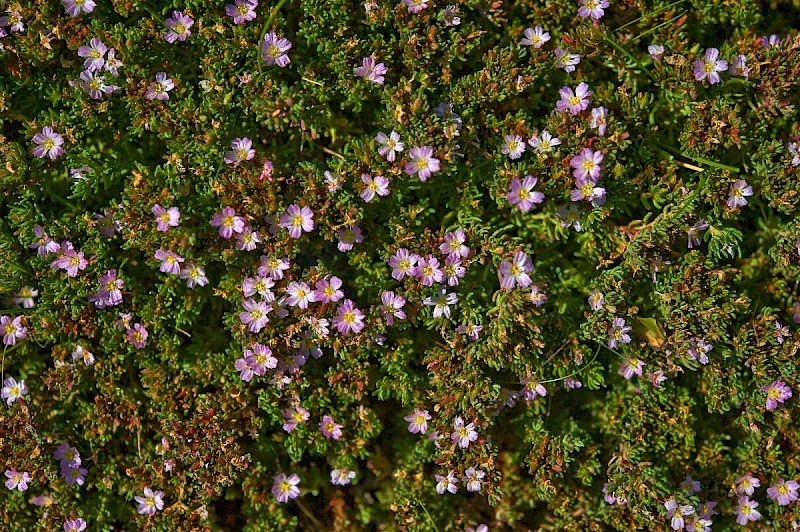
Frankenia laevis - © Charles Hipkin
L.
A prostrate, dark-green perennial which form spreading mats with small. whorled leaves. It grows in the drier, often sandy areas of the upper salt marsh and in the sandy transition zone between saltmarsh and sand dune.. Attractive, small, pink flowers with rather crinkled petals are produced throughout the summer. It has a strictly coastal distribution in England and Wales with a remarkably disjunct occurrence on the coast in northeast Scotland. It is undoubtedly native along the coast of southeast England but some have interpreted its more recent spread westwards along the coasts of southwest England and south Wales as colonisation derived from garden escapes. However, there is no compelling evidence that this is true and it is equally likely that it has been the result of a natural range expansion. It was first discovered in Glamorgan by S. Waldren at Merthyr Mawr in 1981 and then later on Crymlyn Burrows, in 2003, by Tony Lewis. Since then it has colonised large areas of upper salt marsh and transition habitats in Neath Port Talbot, particularly in the vicinity of the Neath estuary and more recently it has began to coonise similar habitats along the south Gower coast. Sea Heath is a suboceanic-southern species which may be expanding its range westward in Britain in response to climate change.
Native


Key: