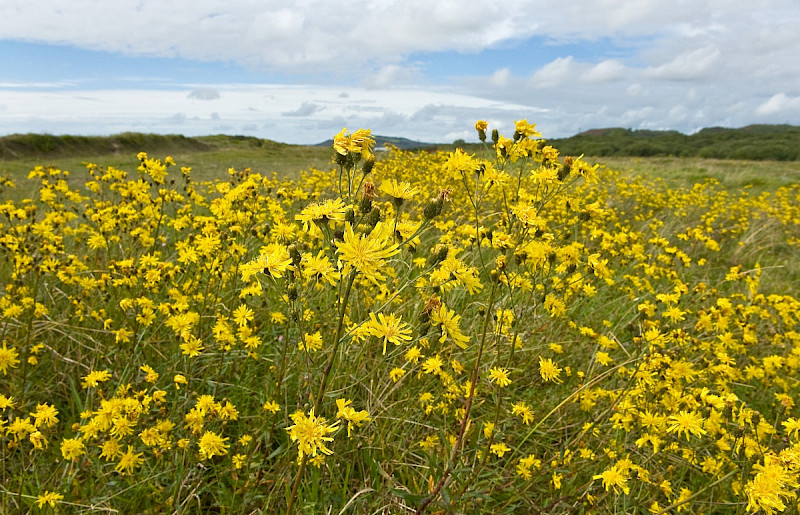
Hieracium agg. - © Charles Hipkin
Hawkweeds are perennial composites, usually with a single stem which supports branched inflorescences of yellow, ligulate florets (ray florets) which are arranged in a capitulum that is enclosed by involucral bracts called phyllaries. It is a very large, apomictic taxon which is divided into 16 Sections. Flora of Great Britain and Ireland, Volume 4 (Sell and Murrell, 2006) provides a dichotamous key to (and descriptions of) 314 species of Hieracium. It is usually difficult to identify a hawkweed unambiguously in the field and even after careful collection and examination, accurate identification is problematic. Key features include the number of stem leaves, their shape and morphology of the teeth along the edge, the length of the involucral beacts (phyllaries) and the types of glandular and eglandular hairs on them. At present there are 3 very useful monographs that provide photographs and descriptions of hawkweeds, Yorkshire Hawkweeds by Vincent Jones (2014), Hawkweeds of South-East England, BSBI Handbook No. 20, by Mike Shaw (2020) and Key to Hawkweeds of Gloucestershire by Tim Rich (2024). Although these are not guides to hawkweeds in south Wales, they describe and illustrate many that are present in West Glamorgan (and many that are not!). Used in conjunction with Atlas of British and Irish Hawkweeds, by David McCosh and Tim Rich (2nd edition, 2018), they provide invaluable aids. Many hawkweeds are native species, a significant number are endemic and some are regarded as introductions (neophytes).
Currently, our understanding of Hieracium in West Glamorgan is incomplete and rather preliminary but we provide descriptions of a few species that we know relatively well.
