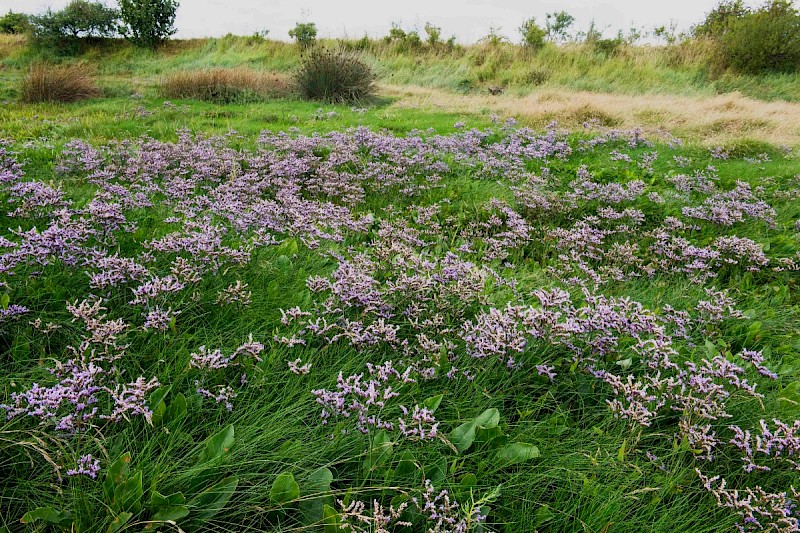
Limonium vulgare - © Charles Hipkin
Mill.
A perennial which is mostly a plant of the upper salt marsh but occasionally grows on sea-walls and in rocky debris near the sea. It is much less a plant of sea cliffs than Rock Sea-lavender (Limonium procerum ssp. procerum) but it sometimes occurs in spray zone habitats. It is intolerant of grazing and more common in salt marshes where grazing is absent or less intense. The leaves are larger and broader than those of Rock Sea-lavender and they have branched veins. The deep lilac, lavender-coloured lowers are produced in crowded, overlapping clusters in flat-topped heads. It is a Mediterranean-Atlantic species with an almost exclusively coastal distribution in Britain, but absent from most of Scotland and entirely absent from Ireland. In West Glamorgan it is a common species of the upper salt marsh where it can provide vivid displays of lavender where grazing is absent, such as in parts of the lower Neath estuary.
In the upper salt marsh, vegetation is inundated with sea water only occasionally when tides are high, but salt-stress is still a problem for plants that grow there. Common Sea-lavender employs a number of strategies which help it to tolerate salt-stress. Firstly it belongs to a class of plants called recretohalophytes which can reduce their salt burden by secreting salt through specialised salt bladders and salt glands. Secondly, their ability to accumulate compatible, osmoregulant solutes such as beta-alaninebetaine, proline and choline-O-sulphate in the cytoplasm of their cells helps to balance the osmotic potential that derives from the dissolved salt in the vacuoles. Saltwater inhibits the germination of its seeds, but they are able to tolerate and survive in seawater and then germinate when flushed with rainwater.
Native


Key: