Lobelia dortmanna - © Charles Hipkin
Linnaeus
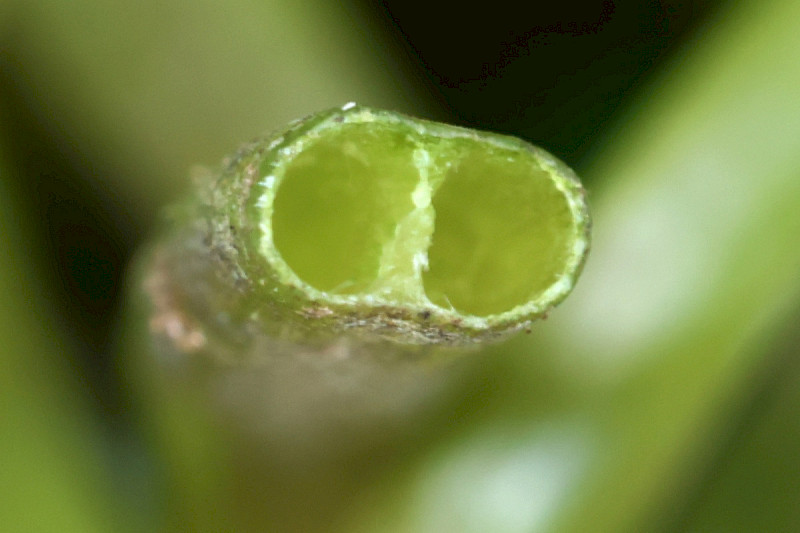
An aquatic peerennial of acidic, oligotrophic lakes and pools. It produces two-lipped, pale-lilac flowers that dropp, on stems that emege out of the water in summer from submerged, leafy rosettes (see photos). The hollow leaves have 2 ('double barrel') lacunae which are obvious if a leaf is cut and vewed from above with a hand lens (see photo). It is intolerant of shade and is usually confined to the shallower water near the shores of large llakes where it may be found in large populations of gregarious indivuduals. It is rarely found in water deeper than 2m. Self pollination is common and may take place in some cleistogamous flowers before they emerge out of the water. Production of seed, which remains viable for mny years, is essential for dispersal and colonisation. Water Lobelia is a Boreal-Montane species which has a western and mostly northern distribution in Britain where it is a characteristic species of mountain tarns. It is locally frequent in nutrient poor-lakes in norrh Wales but it is very rare in south Wales and only found in West Glamorgan where it reaches its southern limit in the British Flora in Llyn Fach, Neath Port Talbot.
Native
Water Lobelia assimilates carbon dioxide generated in the sediment (necessary for photosynthesis) via its roots which is then transported to its leaves via its hollow lacunae which CT s gas channels. This physiological strategy is shared by other aquatic plants such as quillworts (Isoetis species) and Shoreweed (Littorella uniflora), which often grow in oligotrophic lakes with Water Lobelia and share similar morphologies. They are collectively referred to as isoetids.


Key: