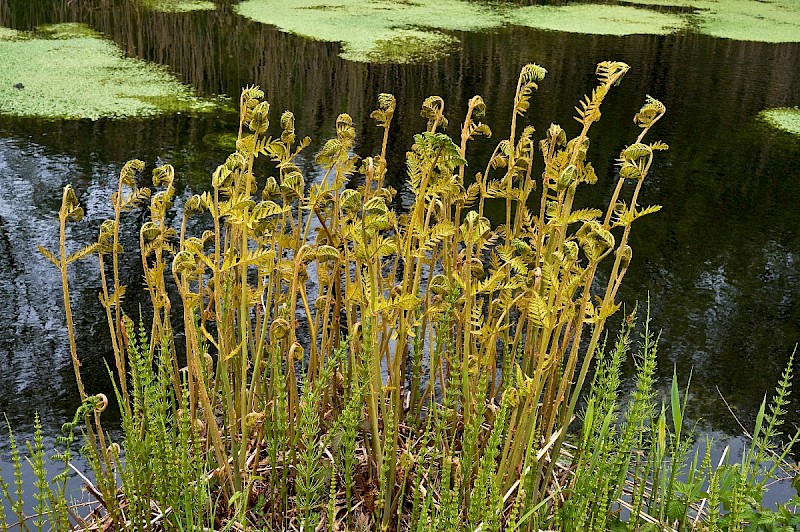
Osmunda regalis - © Charles Hipkin
Linnaeus
The largest fern in the British Flora, which can reach almost 2m in height in favourable habitats. Large pale green, two-pinnate fronds are produced in late spring, some of which bear spikes of brownish sporangia (spore producing structures) that are tightly clustered like upright bunches of grapes at their apex. The spores contain chloroplasts with chlorophyll and after dispersal will germinate and start growing almost immediately under favourable conditions and give rise to the haploid prothallus. Spores that do not find suitable sites do not appear have long-term viability. Above ground parts die-back in autumn. It is a species of wet, neutral or acidic soils on heathland, in poor fen and bogs and on the banks of waterways like rivers and canals. It is a Suboceanic species with a distinctly western distribution in Britain. It is widespread in West Glamorgan and occurs in large numbers in Pant y Saes Fen and along much of the Tennant Canal. Elsewhere it is scattered in suitable places, particularly on the acidic soils of the South Wales Coalfield and on the Gower Commons. It often occurs as single plants or in small populations.
Native


Key: