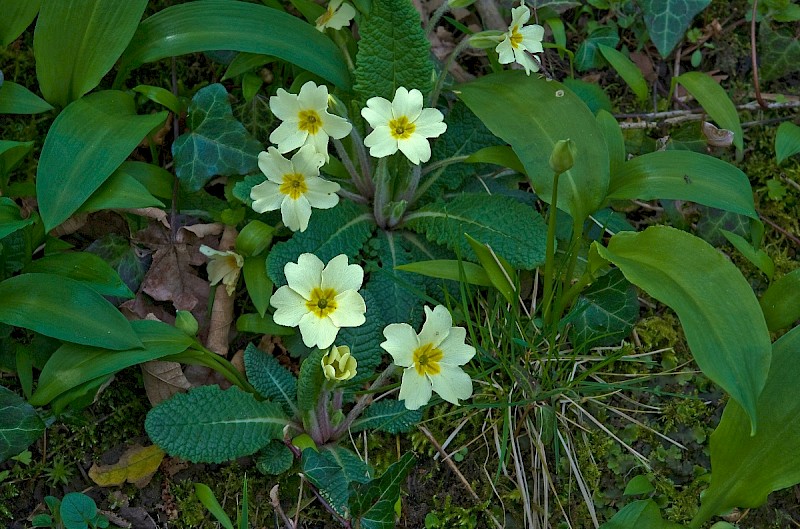
Primula vulgaris - © Charles Hipkin
Hudson
A very familiar, evergreen perennial which grows in woodlands, woodland edges, hedgerows, grass verges and in montane environments.The pale yellow flowers are held on short stalks just above the rosette of crinkly leaves. Some plants in a population produce flowers where the style is positioned above the stamens so that the pin head of the stigma is visible when you look down into flower; these flowers are described as pin-eyed. Other plants produce flowers where the stamens are positioned above the style; these are described as thrum-eyed. This heterostylous condition probably helps to ensure that pollen is transfered between individuals in the population (cross pollination). The deep-throated, nectar-producing flowers of Primrose, and other Primula species, are visited by insects with long probosci such bee-flies (Bombylius spp.) and Rhingia spp who will occasionally transfer pollen between species if populations are growing in proximity to each other. Occasionally, this result in hybridisation, for example between Cowslip (Primula veris) and Primrose (see description of Primula x polyantha). The seeds are usually dispersed by ants. In recent decades, primroses have been deliberately planted in roadside verges and they are now a common sight in such places. It is ubiquitous and common throughout the whole of Britain and Ireland. In West Glamorgan it is common in Gower and is a familiar species of Gower woodlands. Fifty years ago it was an uncommon species in the South Wales Coalfield, but it has been planted in verges and hedebanks in many places in the Neath and Afan valleys in recent decades. However, plants that occur along the river banks and in the river corridor woodlands in Neath Port Talbot are more likely to be derived from native stock.
Native (but planted in many places)


Key: