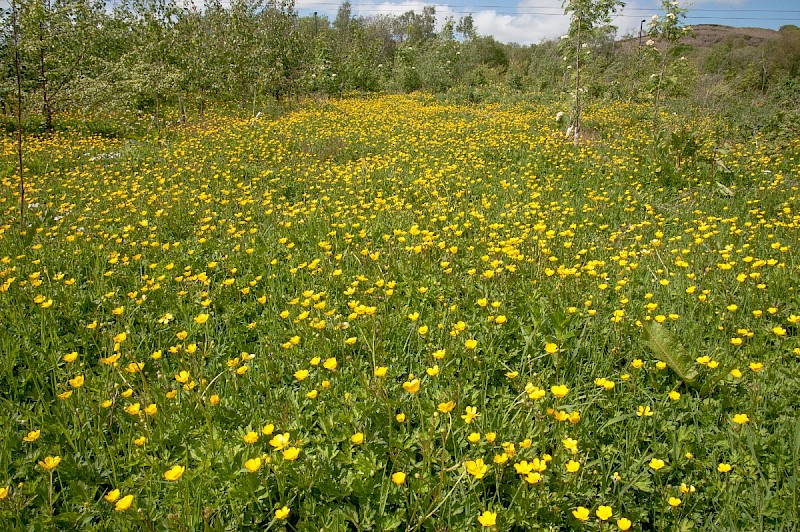
Ranunculus repens - © Charles Hipkin
Linnaeus
A short-lived, perennial, winter-green buttercup which grows in a wide variety of damp habitats, typically grasslands that are not too dry, tracks and verges, dune slacks, waste places and also as a weed in gardens and arable fields. It prefers wetter habitats than Meadow Buttercup (Ranunculus acris) but not permantly flooded or very wet habitats like those inhabited by Marsh Marigold (Caltha palustris). Its creeping stems, which form runners that root prolifically, allow it to colonise disturbed and bare ground very effectively and form large populations (see photo). It can be a troublesome weed which develops resistance to herbicides, builds up significant seed banks in the soil and is able to propagate vegetatively from small root fragments. It differs from Bulbous Buttercup (Ranunculus bulbosus) in its rooting stems and its erect (not reflexed) sepals. The leaves are less dissected than those of Meadow Buttercup, with the central segement on a short but distinct stalk and its flower stalks are grooved (see photo). Although it is not as tall as Meadow Buttercup, it can be large and very robust. It is ubiquitous in Britain and Ireland and one of the most common species in the British Flora. It is very common in West Glamorgan. Like other buttercups it contains significant amounts of a toxic cardiac glycoside, ranunculin, which breaks down to form protoanemonin when leaves are crushed or chewed (see account of Ranunculus acris). It is very distasteful to livestock which tend to avoid eating it.
Native


Key: