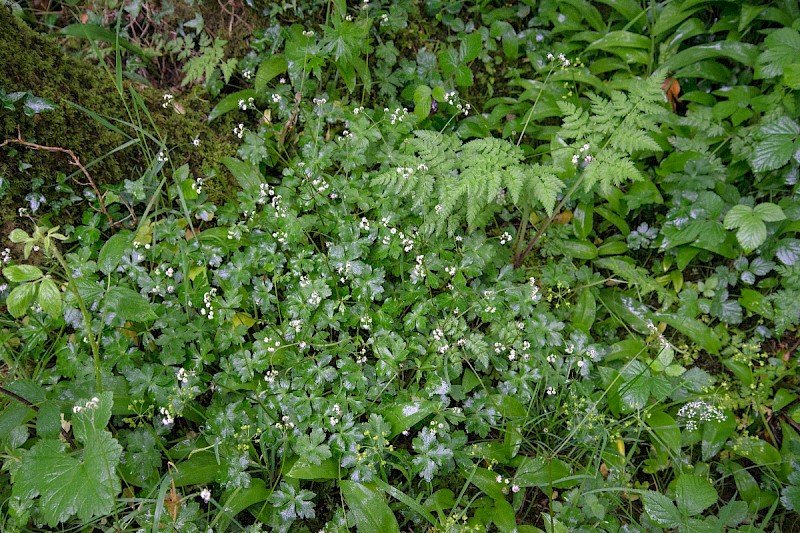
Sanicula europaea - © Charles Hipkin
L.
A common herb in Britain which grows in decidous woodlands, with species such as oak, beech and ash, preferring moist (not wet), neutral or base-rich soils, e.g. at the sides of rivers, and often in quite shaded locations. It produces rosettes of attractive lobed leaves, some of which may overwinter. It is a long-lived, rhizomatous perennial umbellifer, but it rarely colonises secondary woodland so it is a good ancient woodland indicator species where there are established populations. Although widespread throughout most of Britain, it has been lost from many areas where old woodlands and hedges have been removed. Consequently it often has rather local regional distributions. It is a frequent component of the herb flora of Gower Ash Woodlands, growing with Bluebell (Hyancynthoides non-scripta), Ramsons (Allium ursinum), Dog's Mercury (Mercurialis perennis) and Wood Anemone (Anemone nemorosa), but it is never as abundant as those species. It is also frequent in the lowland riparian woodlands of the Neath and Upper Tawe valleys and in some of the subsidiary river valleys such as the Dulais and Clydach valleys. Otherwise, it is rare in the South Wales Coalfield and rarely if ever found in the sessile-oak woodlands that dominate the steep-sided valleys. There is a lot of folk lore associated with Sanicle, often referring healing properties and the ability extracts to stop bleeding. It is rich in triterpenoid saponins (saniculosides), flavonoids and tannins and there is some pharmocological eveidence that supports the synergic roles of these phytochemicals in wound healing. The name sanicle may be derived from the latin meaning 'healer', but this is disputed by some scholars.
Native


Key: