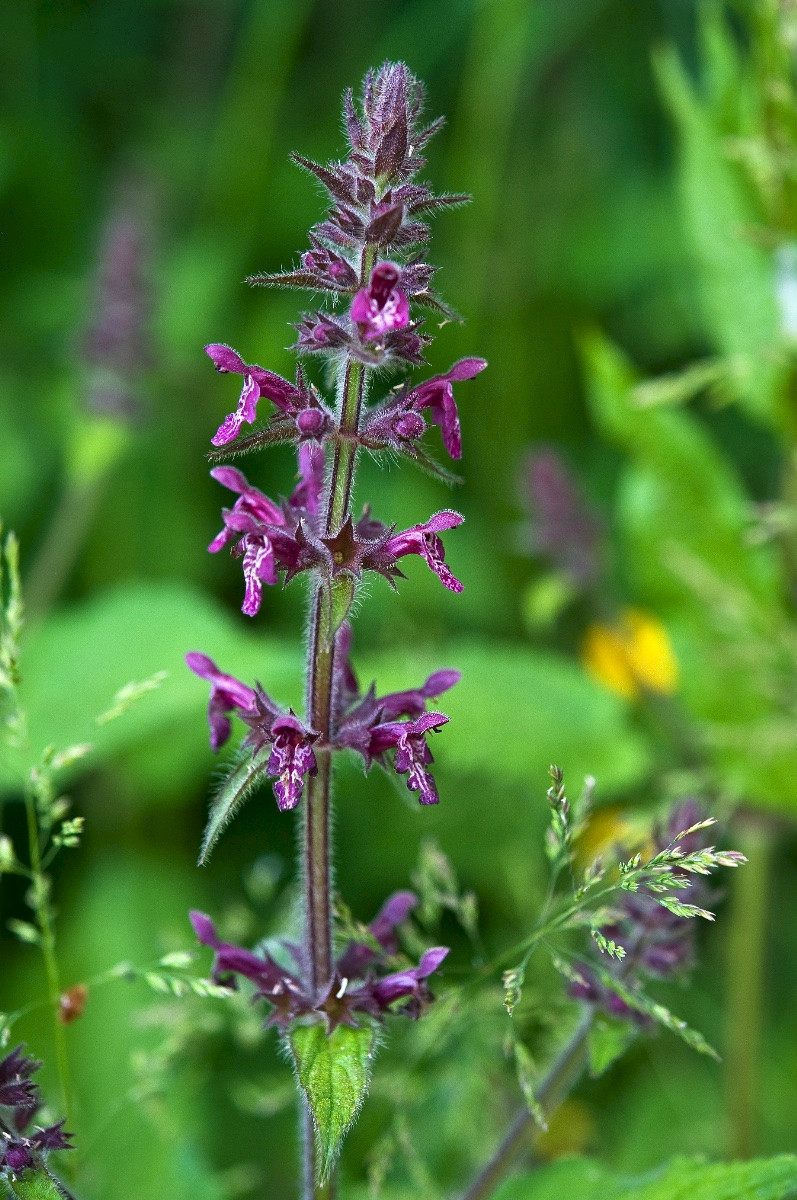
Stachys sylvatica - © Charles Hipkin
Linnaeus
A very common, hairy, perennial woundwort with long rhizomes and a pungent smell, particularly when crushed. It grows in open and shaded habitats such as hedgebanks, open woodland, gardens and waste places. Plants in open sunny habitats are usually smaller, with small leaves and a conspicuous red coloration due to the accumualtion of anthocyanin pigments.It spreads very effectively by vigorous rhizomatous growth and it can be come a nuissance in gardens. It produces a rich and diverse collection of interesting secondary metabolites that include terpenoids, glycosides, phenylpropanoids, flavonoids and phenolics. Extracts from the plant have a significant antimicrobial activity against Gram-positive bacteria. The common name of this plant, woundwort, alludes to its use in folk medicine as an astringent, which causes the contraction of skin cells (and the cells of other tissues) which in turn helps to stop bleeding. There is some evidence to support this but, apparently, this astringency is more effective with extracts from Marsh Woundwort (Stachys palustris). Hedge Wounwort is found throughout West Glamorgan but is less common on the acidic soils in the upland areas of the South wales Coalfield. It hybridises with Marsh Woundwort to form the hybrid Stachys x ambigua, but the distribution of this hybrid is largely unknown in West Glamorgan.
Native


Key: