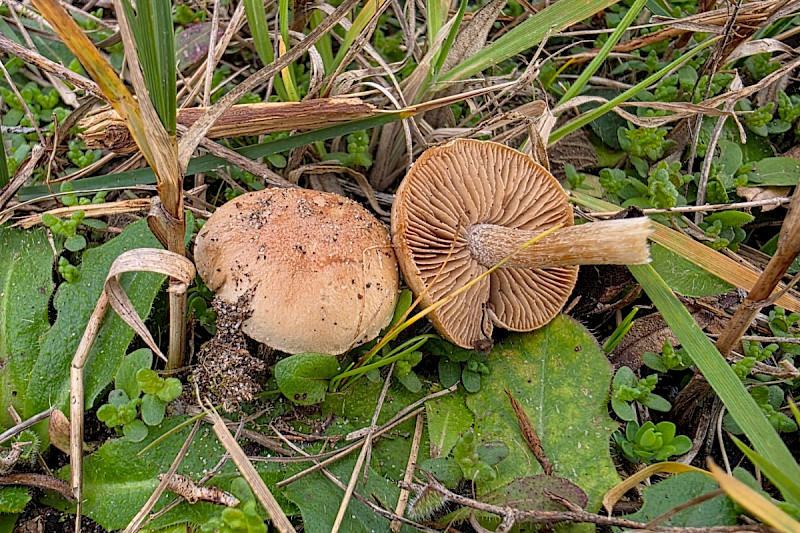
Hebeloma dunense - © Barry Stewart
L. Corb & R. Heim
An uncommon species that occurs on sand dunes in association with Creeping Willow (Salix repens), which produces fruiting bodies in spring. The cap is yellowish-brown in colour, up to about 5cm in diameter (often smaller) with a blunt umbo. Mature caps are a darker umber-brown in the centre giving them a two-tone appearance particularly when dry. The pale stem is often conspicuously scurfy or floccose at the top and there is sometimes a ring zone, but that is by no means a constant or prominent feature. The large, broadly elliptical spores are 12-14 microns long and cheilocystidia are lageniform to ventricose. It is very similar to Hebeloma psammophilum which is bigger and doesn't have such a prominently floccose stem apex. The only collections of this species in West Glamorgan are from Morfa dunes where two populations were found separately by BS and CH in March 2026. There are scattered, coastal records of this species in Britain but, notably, the first record was from Kenfig Dunes in 1992. It is likely to be more widespread on sand dunes in south Wales.
The name Hebeloma dunense is synonymous with Hebeloma velatum Peck and Hebeloma collariatum Bruchet. We have followed Geoffrey Kibby (Mushrooms and Toadstools of Britain & Ireland, Vol. 3ii, 2021) who uses Hebeloma dunense. However, the NBN Atlas uses Hebeloma velatum and Jan Vesterholt, in his monograph (The genus Hebeloma, Fungi of Northern Europe Vo. 3, 2005), uses Hebeloma collariatum.


