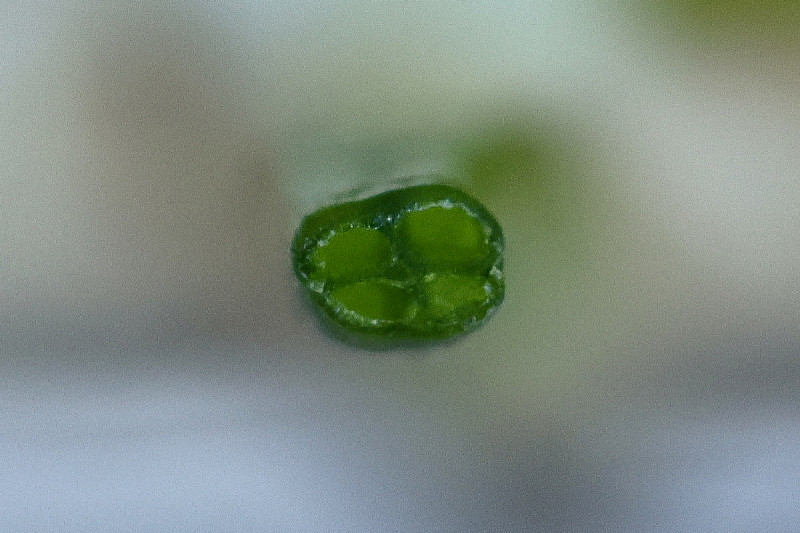
Isoetes echinospora - © Charles Hipkin
Durieu
A rare, aquatic fern which grow submerged in the shalower parts of acidic, oligorophic lakes, such as mountain tarns and in peaty pools. It forms rosettes of narrow leaves which taper gradually to a fine point. The leaves have four hollow channels (lacunae) which can be seen if the leaves are cut and examined with a hand lens (see photo). The inflated bases of the leaves produce spores of two types which mature in late summer and autumn. The larger megaspores are produced singly in the leaves on the outside of the rosette while clusters of the much smaller microspores are produced in the leaves that make up the middle part of the rosette. The inner leaves are sterile. It is a Boreal-Montain species which has a pronounced western and northern distrobution in Briatin where it is on the rare plants register in many of the vice counties in which kt occurs, including Glamorgan (VC41). It is very rare in south Wales and only found in Llyn Fach. Neath Port Talbot, growing with other isoetids such as Quillwort (Isoetes lacustris), Water Lobelia (Lobelia dortmanna) and Shoreweed (Littorella uniflora), The size of the Llyn Fach population fluctuates from year to year but there are numerous plants there in some years. It is similar to Quillwort which is slightly larger and often grows in deeper water. Unambiguous identification requires examination of the mature megaspores, those of Spring Quillwort are covered in fine spines, which are visible with a x20 hand lens. Another identification character that is mentioned by some authors is that the gadually tapered leaves tend to flop and stick together when plants are lifted out of the water, but this is not recommended with a species that is so scarce locally.
Native
Inorganic carbon in acidic, oligotrophic waters in mainly available in low concentrations of aqueous carbon dioxide. Quillworts take up this carbon dioxide at night and assimilate it into carboxylic acids such as malic acid by a process that is called crassulacean acid metabolim (CAM), a type of biochemistry that is employed by desert succulents. This allows them to store carbon dioxide and also to maintain a concentration gradient for carbon dioxide uptake. By doing this at night they avoid competition with other photosynthetic organisms (e.g. algae) that assimilate catbon dioxide during the day. During the day, quillworts close their stomata and release the carbon dioxide that they have stored, which then becomes available for photosynthesis. Quillworts can also absorb carbon dioxide from the sediments in which they grow, via their roots. Carbon dioxide aquired in that way can diffuse from the roots to the leaves via the gas channels (lacunae). This is called the isoetid strategy which is shared by other aquatic plants that live in oligotrophic waters such as Water Lobelia.


Key: